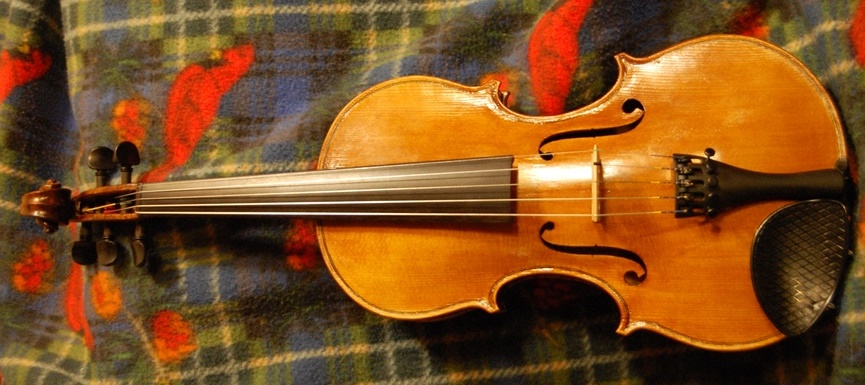
Viola Conversion
Contact from a Potential Customer
A young man contacted me by phone, over a year ago, asking about a large, five-string viola. He was very polite and not at all aggressive or assuming. But he essentially had no money for such an instrument. The phone call was a very pleasant conversation, despite the lack of funds. I was at least able to answer all his questions. We did not discuss a viola conversion. I just never thought of it.
After we disconnected, I simply assumed I would not hear from him again, and eventually forgot about it,
Second Contact: Viola Conversion Proposition
The same young fellow contacted me again. a year later. This time, he had been “saving his money. ” But, unfortunately, not quite enough for a handmade commissioned instrument. So we talked over the options.
Eventually I offered to convert one of my earlier orchestral violas to a five-string viola at the price he could afford. He liked that idea, and eventually, after his final approval, I began the project.: A Large Viola Conversion to a very large five-string Viola.
Conversion Donor: An older 16-1/2″ Oliver Viola
I began with this viola– my own design. The viola played quite well, but, for some reason, no one had purchased it, so far. (It was instrument #11, viola #4 from my Bluefiddles site.)
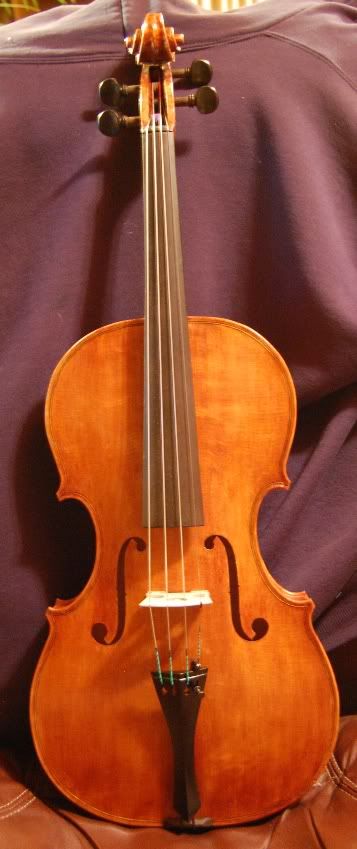
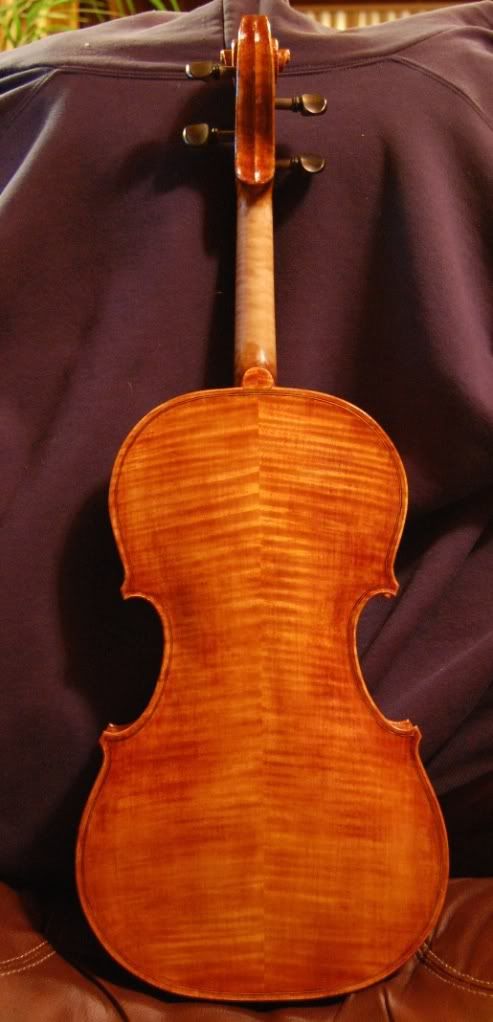
Conversion: The Plan
As I usually keep my viola necks fairly narrow, for player comfort, I needed to make a slightly wider fingerboard and nut, to accommodate the fifth string.
Obviously, I also needed to plug three of the peg-holes and drill four new ones. They had to be positioned so that all five would fit on the pegbox, and the strings would still not rub on another peg, when tuning.
Conversion Photographs
I did not take any photos of the fingerboard and nut changes, but here are a few photos of the scroll in progress. (Also, midway through the conversion, he asked whether I could darken the varnish. That really had not been part of the “deal.” But, after thinking about it, I decided that I could try to do it with minimal labor, and just count it “good customer relations.”)
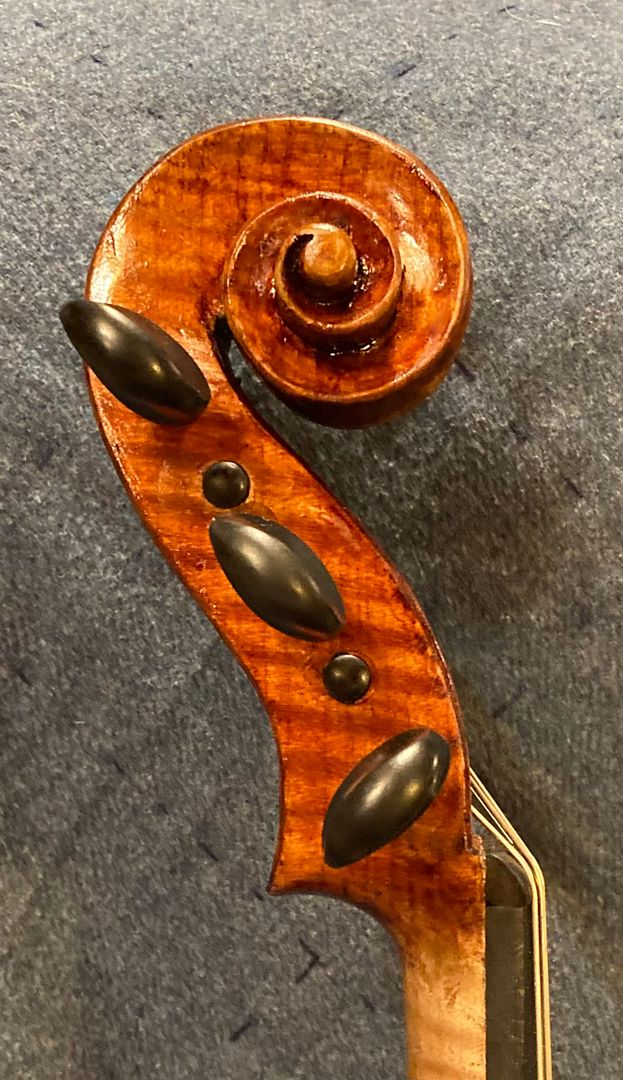
So: here are some photos of the scroll after plugging the original holes and drilling new ones. I capped all the plugs with figured maple, to avoid leaving the dark circles which usually remain after such an operation.
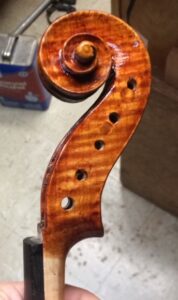
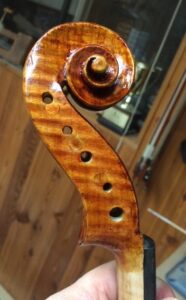
The different background and lighting (shifting position, trying to eliminate reflections) resulted in different apparent color…but they actually match.
Adding Color
About the time I reached this point in the conversion is when the customer requested the color change. It turned out that he liked the color of his current instrument, and hoped I could mimic that somewhat. 🙂 (Okeedoke...)
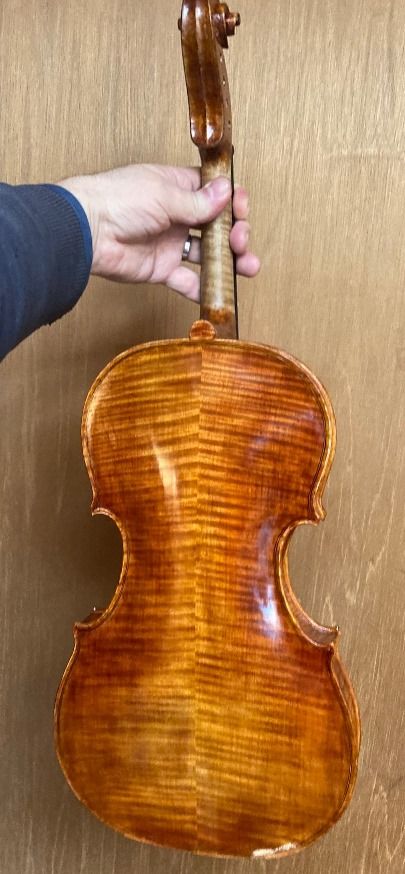
So, I began adding color; sparsely, at first, until I could see how it was building. About three very thin coats of a dark, red-brown varnish were required to offset the original golden brown, and produced the color that he wanted.
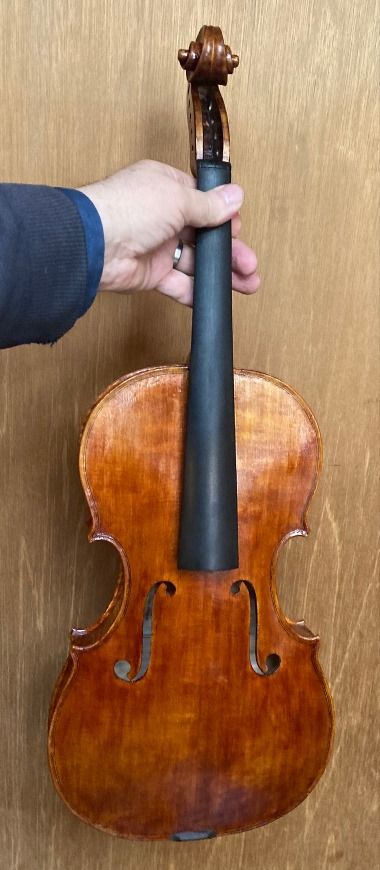
Set-up and completion
At the point where I felt things were beginning to look correct, I added a clear coat, and allowed it to dry for a few days before setting the instrument up. But then I set it up with Evah Pirazzi strings, and it hung in my dining room, where it could dry still further, while waiting for a check to arrive. (This is where I frequently hang my instruments for final drying, as it is usually the warmest room in the house.)
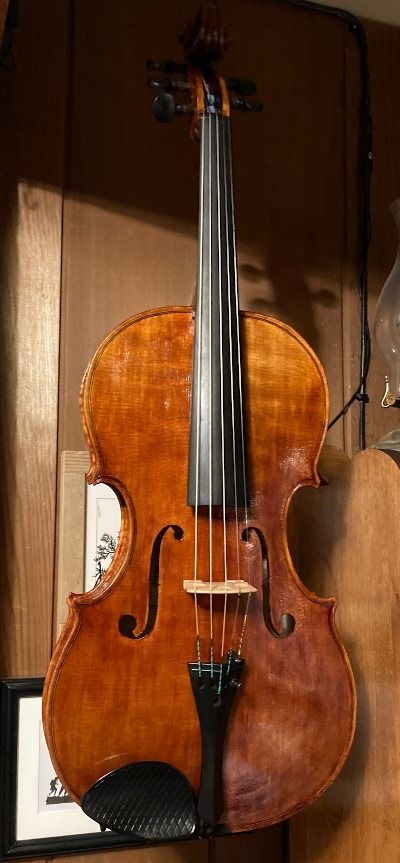
Finally, a check arrived, and I first sent a provenence document with clear photos of the instrument for identification purposes, (for insurance purposes, and, in case of theft.)
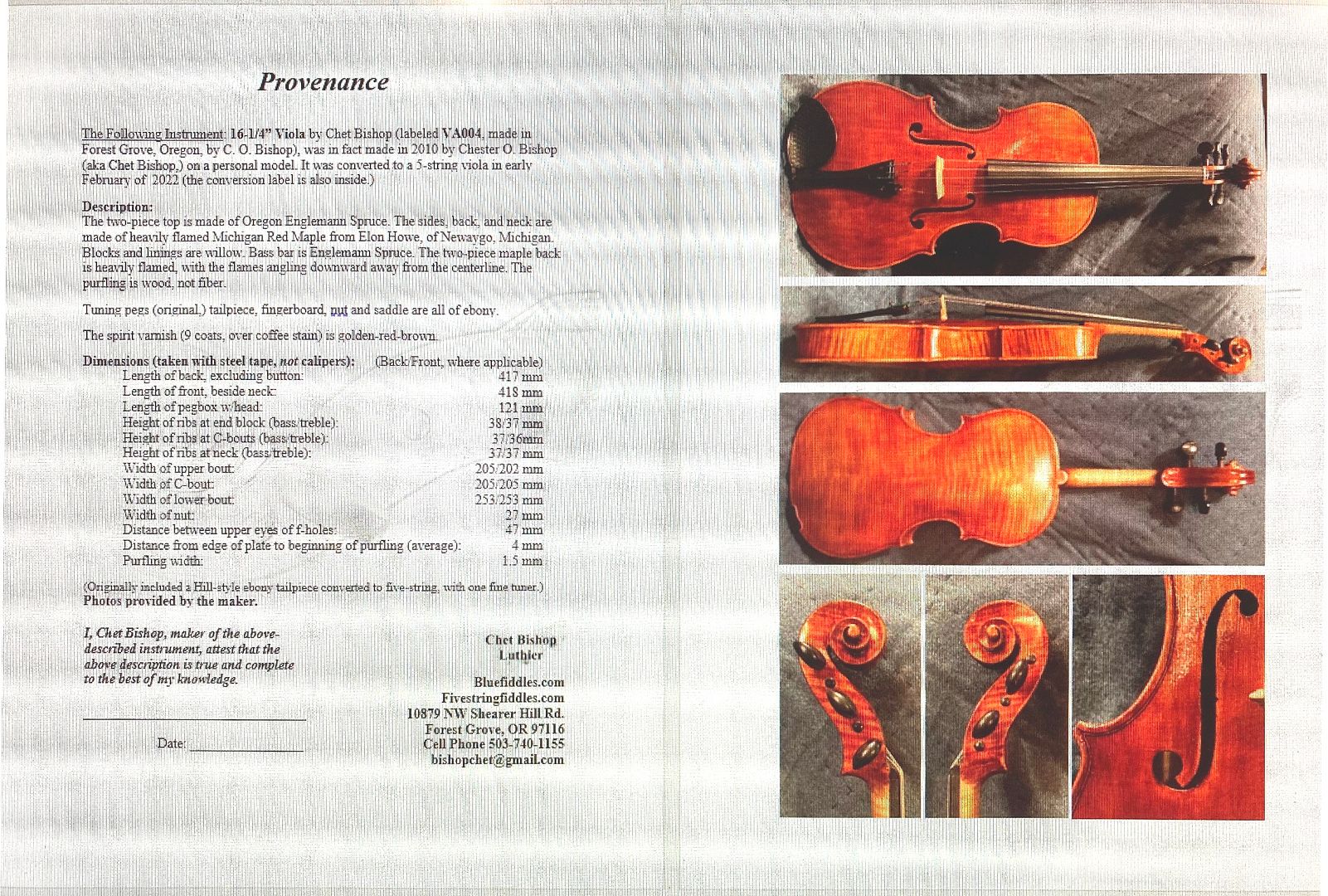
Provenance Document for Viola Conversion
I always include a provenance document for my hand-made instruments, along with the bill of sale. That way, if the instrument ever gets stolen, they have clear proof that the instrument is theirs, along with good photos by which to identify it. The front page includes a dozen accurate measurements, and the back side (Two-sided document) has all the photos.
Viola Conversion Shipping
Finally, I packed it carefully and shipped it off.
The 5-string viola arrived five days later, undamaged and still in tune. Most luthiers only ship their instruments with the strings slack and the bridge down, to minimize the chance of damage.
I don’t want to make the customer set-up the instrument, so I carefully wrap and pad the instrument inside a good case. Then I pack the case in an oversize carton, with yet more padding, and so far, the instruments have arrived safely, and usually still in tune.
Soundpost Magic
The problem, for me, is that I’m not confident that the customer has access to a luthier who can set up and adjust five-string instruments. The soundpost fit and position is critical to the balance across the strings. That balance is especially touchy on a five-string instrument, and not everyone succeeds at it.
People often tell me their 5-string fiddle sounds “dead” on the C-string. A five-minute readjustment of the soundpost brings it back into perfect balance. So…I go ahead and ship them fully set-up and ready to play.
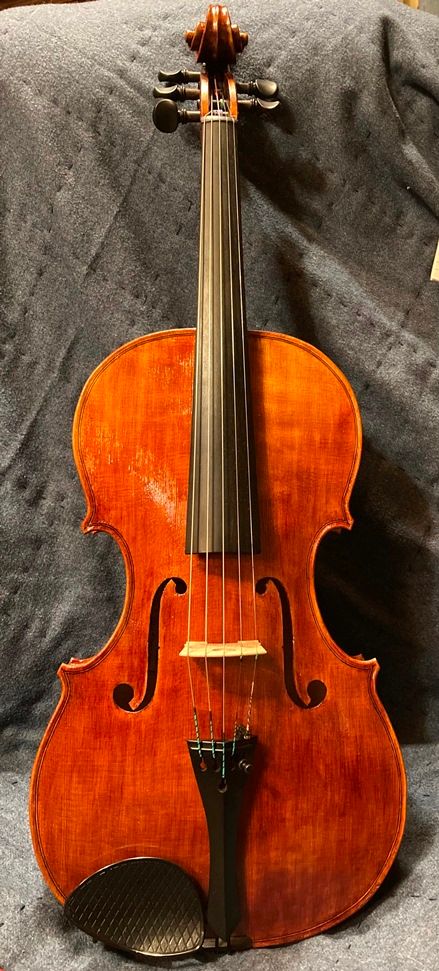
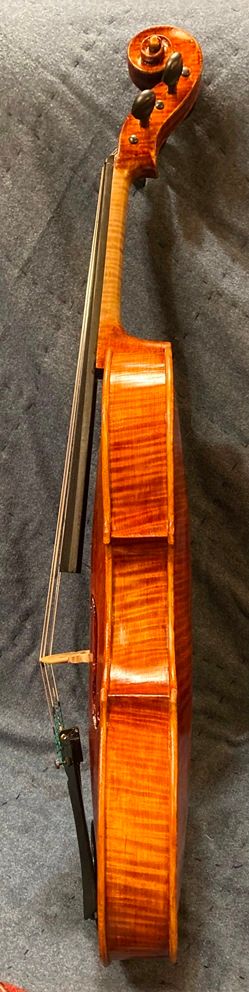
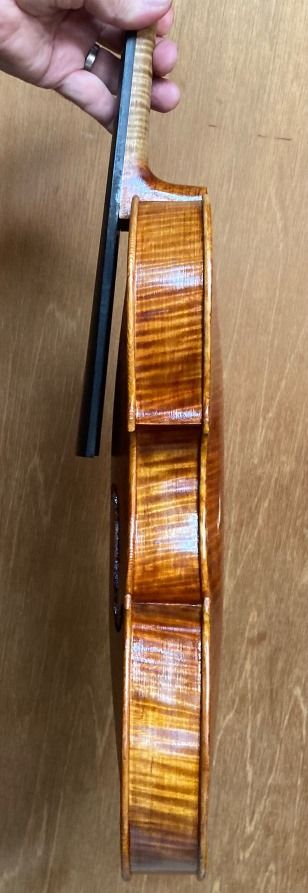
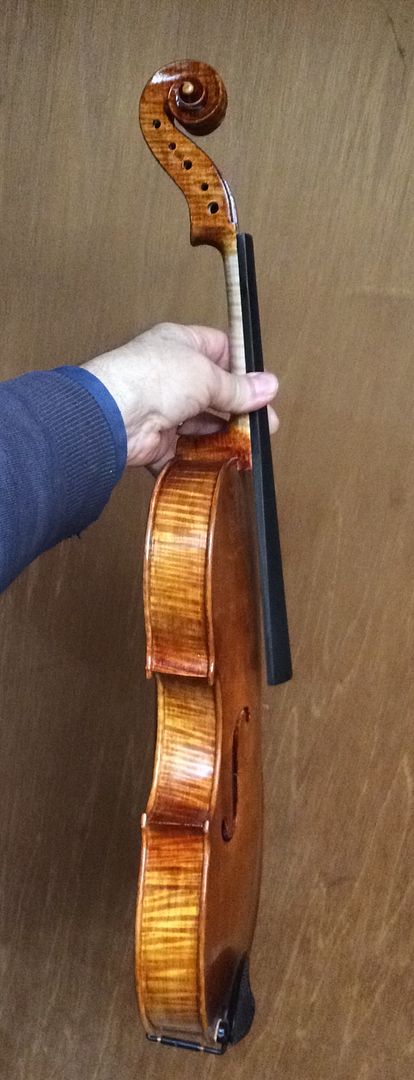
Side view, final appearance,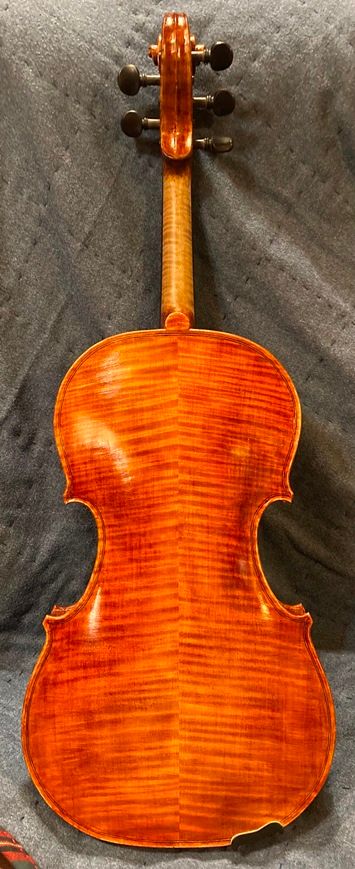
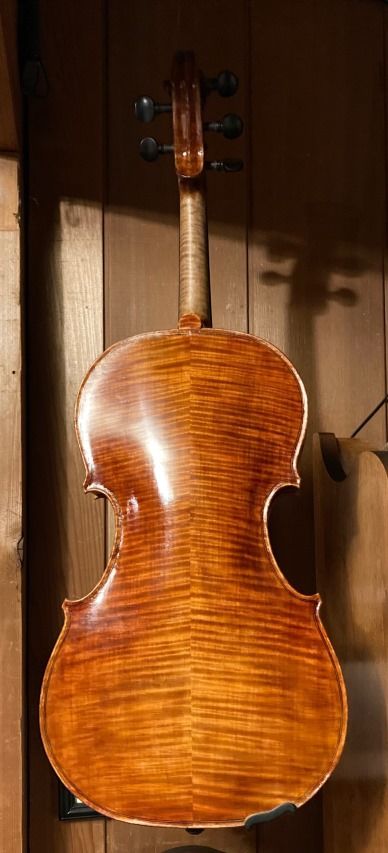
Final appearance, back.
The customer loves his new Viola. He is thrilled with his new five-string, and is practicing the Bach Cello Suites on it now. He promised to send a video, once he gets accustomed to the “five-string feel,” so when the video comes, I will add it to the website.
Thanks for looking.
A handsome transformation! Your work in plugging the holes is beautiful! You also did this in correcting some errors my Dad made to his cello, and your repairs are absolutely invisible, Chet. I look forward to hearing your customer’s Bach on that gorgeous Oliver!
So do I, Miss Maryanne! I hope he keeps us posted!
Chet
I’m a 5 string violin dabbler. I have an electric 5 string violin I bought four years ago and I’ve been trying to familiarize myself with it. I use a study book by Daniel Douglass Smith. And I’m only working on the first song in the book. The fingering is unclear to me in places, but I’m hoping to feel like I can actually play the song some time in the near future. I’ve also been playing a youth 1/2 size 4 string violin made in Japan and is a model of an Antonus Stradiverus I like it for my hands are small. Would you consider making a 3/4 size 5 string violin? Is that possible? Are 3/4 size C strings available? Of course, the cost would be far more than I could pay at this time. But then, if it is something possible to pursue, perhaps I could plan to save for it to buy in the not too far future. Your website shows your craftmanship quite well! Thanks for taking the time to consider my request.
Mr. Woolf,
I sent you an email…