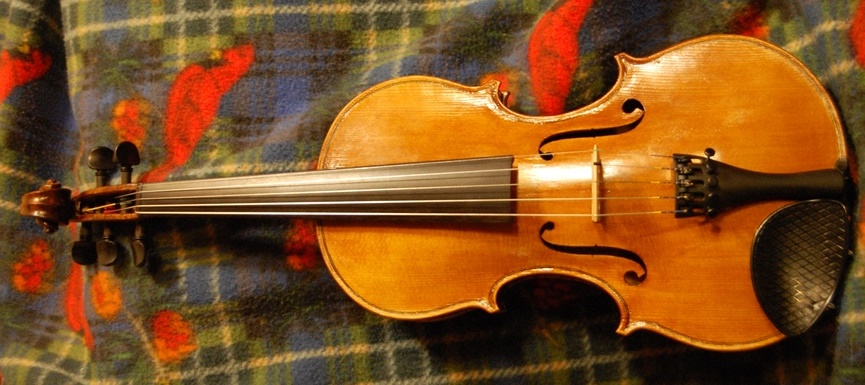
5-String Fiddle Linings

Why Linings in a 5-string Fiddle?

What is the use of linings?

In most of the members of the violin family, including the five-string variants) there are narrow strips of wood glued to the inside of the ribs, all around the edges, called linings. On some double basses the linings are actually on the outside of the ribs,  as well as the inside, following the edge of each rib. The purpose is the same in either case: it is to strengthen the very fragile rib material as well as tripling or quadrupling the thickness of the gluing surface at the edge of the rib. This is so that the rib garland can be securely attached to the front and back plates, also making it possible to remove those plates without breaking the ribs, when repairs are needed.

Wood for linings

I like to use willow for my linings when it is available, because it is easy to bend and fit to the ribs, as well as being very easy to carve, when it is time to taper those linings, and make them fair into the inside surface of the rib structure. Many makers use spruce, and I have done so as well, but have decided that I prefer willow. In fact, when I can get it, I specifically prefer Weeping Willow above anything else I have tried.

Installing linings

So…I arrived home fairly tired this evening, but I fired up the glue-pot, and prepared to install some linings: You can see the center bouts on the right-hand instrument’s ribs are already in place, making the edge 3 mm thick, instead of barely 1 mm.

When I pre-form the linings, I begin by using my bandsaw to cut a “plank” of willow, 3 mm thick, then thinning it to a very consistent 2 mm thickness. I use a “wheel-style” marking gauge, set to 7 mm width, to deeply score the “plank” along one edge, then flip it over and score the opposing face, effectively cutting the rib free from the “plank.”  Then all I have to do is bend those linings blanks around my bending iron, and produce a pile of “ready-to-use” linings for my violin ribs (see below.)
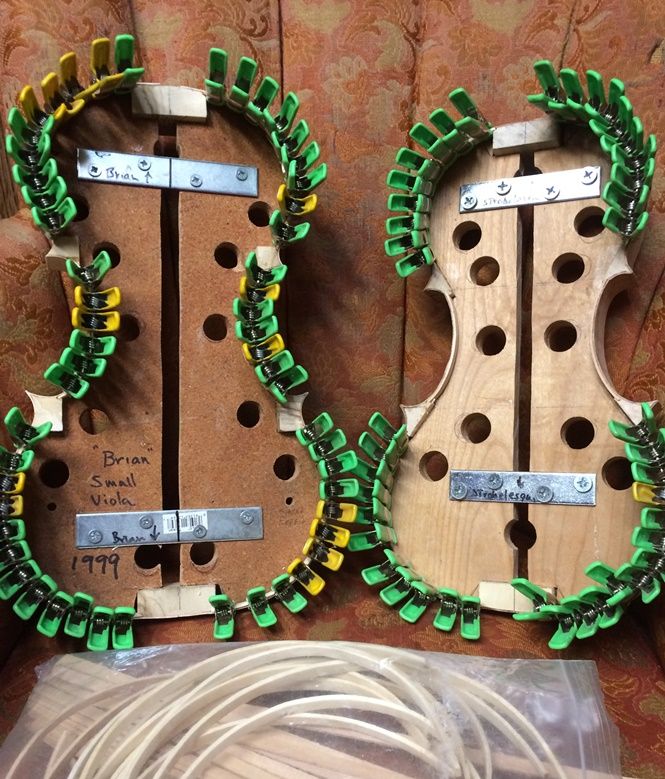
linings in five-string viola and 5-string fiddle
Rib linings in the 14-7/8″ 5-string viola and one of the 5-string violins. In the foreground you can see the linings I have pre-formed to approximately the required curvature .

I use a small sharp knife and a tiny gouge to make a small mortise in the junction between blocks and ribs (12 places on each face of the garland.) I only use hot hide glue on instruments, but the hot hide glue cools and gels rather quickly, so I cut the pre-formed linings to the proper length, and fit all of them into the garland, dry.  One by one, I then remove each lining, coat it liberally with hot hide glue, and quickly re-insert it into the tight-fitting place prepared for it.  I pinch hard, with my left forefinger and thumb, to squeeze the joint tight, and then use my right hand to apply a spring clamp. I move over a half-inch, and repeat, until the whole lining is tightly secured with glue and clamps. The little spring-clamps will hold the freshly glued linings in place until the glue hardens.

The same principle works for larger instruments, but the ribs are bigger, and I use bigger clamps.

Anyway, that is all I accomplished this evening. Possibly tomorrow I will get the rest of the linings into the other instruments.

Once the linings are in place, the ribs are a good deal less fragile, and less prone to breakage. That is a relief, as they are really easy to break, without the linings.

Follow along and see the whole build!

Thanks for looking!

Aha! Blog posts are now visible!

I am grateful to the patient staff at NameCheap, who walked me through to a satisfactory conclusion to the problem I have been having with this website.

I had inadvertently set upwhat amounted to a continuous loop, whereby the posts went to the page to which they were originally assigned, but then were redirected to another page, and back again…at least, that is how I now understand the error.

At any rate, now, when a visitor opens the site, they see the home page, and then can see at the top of the page an item called “Blog Posts.” And, there they are!

So…you can expect to see more progress reports and photos, as the days go by.

I should have a 14″ five-string viola nearly finished in the next week, or so, as well as good progress on a 14-7/8″ five-string viola and two five-string violins (fiddles).

On the other hand, we have company coming next week, so there is much to do in preparation for that visit, so perhaps it will take a little longer. Either way, the whole website is now functional, so I am happy.

🙂


Thanks for looking.

Five String Instruments

Five-String Fiddles

I get a fair amount of demand for five-string fiddles; in my case, that means a five-string instrument with the same footprint and scale-length as a violin, but with the added C-string, so that it carries the full range of both a violin and a viola. I have mastered this genre to the point that the low end of my five-string fiddles sound like a good, small viola, and the high end sounds like a good violin…and the neck width is just barely wider than that of a violin (25 mm) so that it plays like a violin.

Teachers like them, because they can teach the viola part or the violin part, without having to change instruments.

Wood Selection

One of the beauties of a five-string fiddle is that, because it is non-traditional, I am not under the burden of using traditional woods, so I am free to experiment, and, as it turns out, there are other woods that work quite well: I have made them of domestic woods; Big Leaf Maple/Sitka Spruce (or Englemann Spruce), but I have also used Koa/Sitka Spruce, Myrtle/Port Orford Cedar, and all these combinations worked quite well. I will soon try a five-string fiddle of Bubinga and Sitka Spruce and am open to other experiments.

I will continue to build and sell five-string fiddles either on speculation or on commission, as the demand increases.

Five-String Violas

I am beginning to hear a call for Five-String Violas as well. These have the same range of pitch as a five-string fiddle, but the physical instruments are whatever size viola is preferred by the customer. Though I have already built several sizes, until I get an increased demand, these will likely remain as custom commissions, not just built on speculation, such as how I currently produce the five-string fiddles.

The practical difference, then, between a five-string fiddle and a five-string viola, is that the (usually larger) five-string viola will usually have deeper, richer, louder tone, just because it has a larger resonating body, both of air and wood. But not everyone can comfortably play a larger instrument, so this is a matter of personal choice.

Five-String Cellos

Five-string cellos are not a new thing. The cello-piccolo and the cello da spalla (Sometimes also called either “Violoncello da Spalla” or “Viola da Spalla”)  have been extant for centuries, and music has been specially written for both. I hope to see a rising demand for these instruments, but, for the moment, they are a rarity. I can build both, and hope to soon have some to display here, but, for the moment, I do not. I have had customers ask about them, but usually, it was just an idea they had, and they were not prepared to place an order.

Five-String Double Basses

Five-string double basses are increasingly common, as people want the freedom to reach for lower bass notes, and not have to have a “B-Extension” added to their bass (which can also be done, of course, but it does add length to the bass scroll, and an additional source of fragility.)
I build an occasional double bass, but they are a lot of work, and they completely monopolize my small workspace when they are a work in progress; so I am more likely to default to smaller instruments. There is a special thrill, however, in building a huge instrument, seeing the beauty of the beast, and feeling the floor shake when I draw out long bass notes with the bow. I can certainly understand why players fall in love with the double bass, and especially the five-string double bass, with the lowest-of-the-low B-string at their beck and call.